Putin Says, "No Problems Here"
Putin said Ukraine could not cause serious problems. Then, refineries burned, a concert moved indoors, and Russian war channels described the road being cut.

Russia Day is supposed to be a portrait session for the state.
The flags come out. The choirs arrive. The television graphics arrive in the colors of destiny. Officials speak of unity, sovereignty, historical continuity, and other load-bearing abstractions. June 12 marks the Russian Federation’s declaration of sovereignty, the founding of the presidency, and the beginning of the Soviet collapse. It is the birthday of the modern Russian state, or at least the authorized edition.
This year, the portrait session was filled with smoke.
That was inconvenient, because Vladimir Putin had a line ready. Ukraine, he said, could not create serious problems for Russia. Damaged infrastructure would be restored quickly.
“We are quickly restoring,” he said. “There are no problems here.”
That would have been a cleaner message if the rest of the day had cooperated.
The Facilities
Ukraine’s General Staff did not mark Russia Day with an essay about imperial decay. It named facilities.
In Tatarstan, Ukrainian drones reportedly struck the Tatarstan Oil Refining Complex and TAIF-NK. In Nizhnekamsk, smoke rose over one of Eastern Europe’s largest petrochemical zones. In Tolyatti, on the Volga, Ukrainian officials said that a rubber plant tied to solid-rocket fuel production had been hit.
These are not symbolic targets in the easy sense. Petrochemicals do not look like conquest. Synthetic rubber does not stand at a podium. A refinery does not wave a flag. But a missile needs more than a speech. It needs propellant, seals, cables, fuel, rail links, a workforce, and a man somewhere inside the machine whose job is to make the complicated thing do what the ceremony promised.
Nizhnekamsk is more than 1,200 kilometers from the nearest Ukrainian border. Smoke over a place like that is not a slogan. It is a measurement.
Putin said there were no serious problems. Ukraine’s General Staff named the plants.
The Road
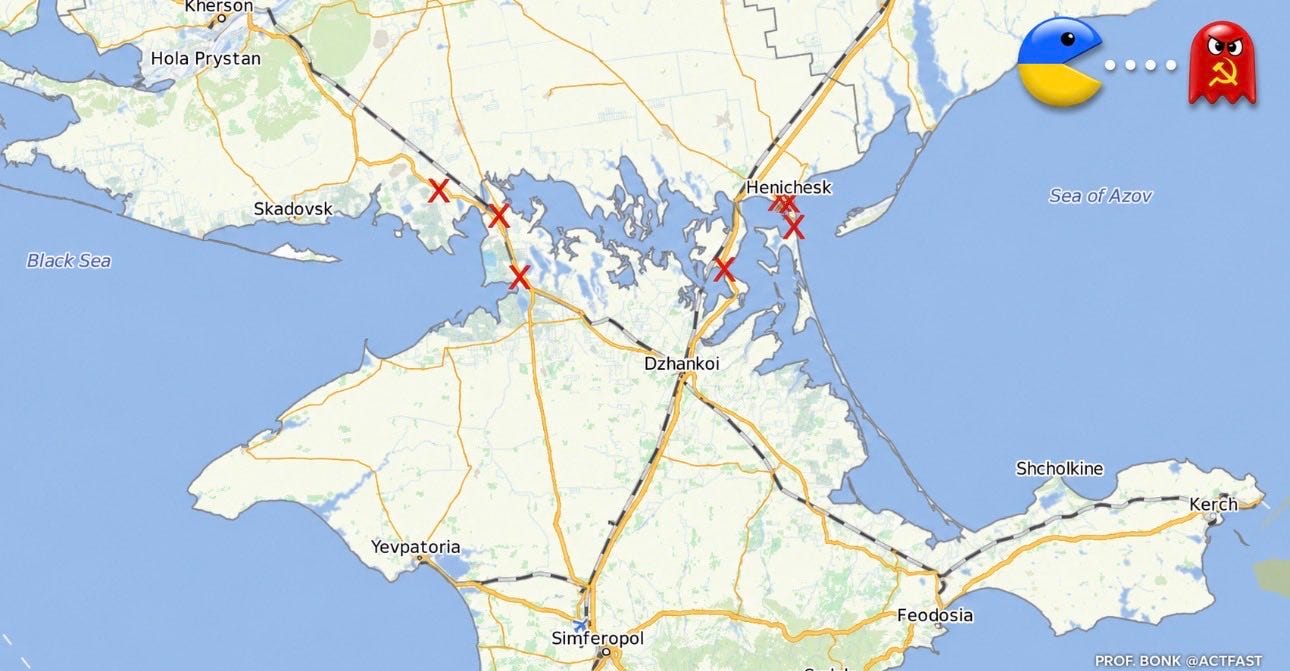
Ukraine’s Da Vinci assault regiment said it struck the Armiansk Bridge, the crossing that ties occupied Crimea to the Russian-held mainland, and destroyed vehicles carrying fuel and ammunition.
Russian war channels described the same pressure in their own language. Ukraine, they wrote, was spending serious resources and many drones to cut the land corridor to Crimea. Bridges, detours, and the routes that keep the occupation connected were becoming targets. The bluntest Russian-side judgment mattered more than any Ukrainian boast: militarily, the effort was logical.
A bridge is never only a bridge in this war. It is a sentence in concrete: this road is open, this occupation is normal, this map is real. Hit the crossing, and the sentence has to be rewritten.
Russian official language is built for that kind of inconvenience. Explosions become “cottons.” Fires become “smoke events.” A dangerous road becomes temporarily restricted. Ukraine’s reply has been plainer: hit the crossing, hit the fuel, make the occupation explain itself at ground level.
Crimea was supposed to feel irreversible, a postcard from destiny with beaches, bases, bridges, and tourists treating annexation as a holiday package. Ukraine has not taken it back. It has made Russia run the peninsula under pressure.
Moscow can still color Crimea on the map. It has a harder time making the fuel and the road behave like the coloring.
The Concert
The Moscow centerpiece was reportedly a concert titled “In the Unity of the Peoples Lies the Strength of Russia,” a phrase that sounds as if it arrived already engraved.
Then the show moved.
The main event moved off Red Square into an indoor hall. Celebrations in Nizhnekamsk, Tolyatti, and Samara were trimmed or scrapped. Airports restricted flights. Nizhnekamsk’s mayor, Radmir Belyaev, gave the official reason: the festivities were called off “to ensure safety.”
“In the Unity of the Peoples Lies the Strength of Russia” was the poster. “To ensure safety” was what the poster said once drones were overhead.
The holiday wanted a choir. Belyaev handed it a risk assessment.
A refinery fire ruins the altitude. Flags are supposed to lift the eye above the potholes. Instead, the eye drops to the pipelines, the substations, the nervous mayor, the airport notice, the event moved indoors.
Smoke makes it feel flammable.
The Denial
Then, Putin supplied the best witness against himself.
Ukraine could not create serious problems for Russia, he said. Damaged infrastructure would be restored quickly. “There are no problems here.”
Then he promised to intensify the strikes on Ukraine.
Those two claims can stand close together without much commentary. If the damage is trivial, it does not need to be avenged. If the strikes cannot cause serious problems, they do not need to be made to stop.
Russian official language did its part. Refineries and rocket-fuel plants became “civilian infrastructure” the moment a Ukrainian drone arrived. Ukrainian power stations and apartment blocks became legitimate targets because Moscow had a grievance. What Russia needs for its war is civilians when Ukraine hits it. What Ukraine needs to survive is military when Russia destroys it.
A man does not vow revenge on a mosquito. He swats it.
Putin was not answering a Ukrainian boast. He was arguing with the smoke.
The Price
Before dawn, Russia launched 117 long-range drones at Ukraine. Ukraine’s air defenses claimed 102. Fourteen got through across seven places.
In Sumy, daylight artillery hit eight locations. The governor said it was the third artillery strike on the city this year. A drone killed a railway worker.
In Mykolaiv, Shahed drones struck a transport yard and put a man in the hospital. Vitalii Kim, the regional governor, did not need a paragraph of outrage. He filed the report.
“A man was injured and has been hospitalized. Buildings belonging to a transportation company and vehicles were damaged.”
A man in the hospital before breakfast is the whole of it.
DTEK said a thermal plant was hit and a worker was killed. Dnipropetrovsk counted more than fifty strikes. A missile struck a solar plant in the Odesa region.
Russia called it a response.
The Purchase Order
Robert Brovdi, the drone commander known as Madyar, did not ask to be pitied. He asked to be funded.
“The production capabilities, the quality of drones, and the number of crews operating in Ukraine are enough to inflict devastating blows on the Russian economy, clog their logistics and kill personnel,” he told Reuters.
What Ukraine lacked was money.
Not applause. Money.
Ukraine plans to request roughly $20 billion at the next Ramstein meeting. Brovdi’s case is not sentimental. Ukraine has found pressure points. He wants to buy repetition.
Oleksandr Syrskyi gave the official arithmetic from another angle: nearly 180,000 targets hit by drones in May, hundreds of them headquarters and command posts. Wartime numbers should be handled like hot metal rather than scripture, but even hot metal shows what the forge is shaping. Ukraine is trying to make drone warfare into an accounting system: not only can the soldier at the front be killed, but the tanker can also be hit before it reaches the unit, the plant can be burned before it feeds the missile, and the bridge can be made unreliable before the convoy arrives.
None of that runs on courage alone.
While Moscow staged statehood, Kyiv announced duller things: better infantry pay, fixed terms of service, cleaner contracts, and a route back for men who went absent. Mykhailo Fedorov described the new system as one built on “respect for the individual, justice, and clear rules.”
Russia can push soldiers forward through poverty and the police station. Ukraine has to persuade them, because it cannot spend people with Russian indifference and remain the country it is defending.
Bureaucracy is what courage becomes when it has to outlast a slogan.
The same logic runs through the workshops. Ihor Fedirko said Ukraine had signed nearly twenty joint-production deals with European partners. Skyfall signed with Airbus in Berlin. The point was not romance. It was capacity.
The European Room
Russia invaded to keep Ukraine in Moscow’s sphere. On June 12, Europe answered with a calendar entry.
All twenty-seven EU members agreed to open the first cluster of accession talks with Ukraine and Moldova: rule of law, institutions, founding values, the part Brussels calls the fundamentals. European Commission President Ursula von der Leyen called it “the backbone of the accession process.” Volodymyr Zelensky said Ukraine had fulfilled the necessary requirements and that Europe was “keeping its word.”
Next door, the soprano Anna Netrebko was booked into a hall in Luxembourg that called itself a place of dialogue and insisted the choice was not political. The exiled artist Katia Margolis drew the better line: being Russian is no crime; laundering the reputations of people and institutions that backed the regime is something else.
Lavrov supplied the companion note from Moscow. Ukraine, he said, must restore the privileges of the Russian language as a condition for a settlement: a tender concern for pluralism from the army that shelled the schools where the language was taught.
The Missile
Even Russia’s threat pointed back to the machinery.
Ukraine’s Air Force said there was a high probability that Russia would fire an Oreshnik, an intermediate-range ballistic missile, from Kapustin Yar within a day. Zelensky urged Ukrainians to take air-raid alerts seriously. The missile had flown before with an inert payload, which is the point: a nuclear-capable warning shot, a weapon used as punctuation.
When the refineries burn, Moscow talks about escalation. When the rubber plant is hit, Moscow mentions ballistic missiles. Every Ukrainian strike is supposed to end in a discussion of what Russia might do next.
But a missile is not a tantrum in the sky. It has fuel, guidance, a launch site, maintenance crews, and supply chains. It belongs to the same unpoetic world as Nizhnekamsk and Tolyatti.
The missile still needs a factory.
The Invoice
Germany’s army chief, Christian Freuding, supplied the European version of the warning. Russia could be able to strike a NATO country by 2029, perhaps sooner, he said.
“Speed is of the essence now.”
A Russian army doing badly in Ukraine is not therefore safe. Freuding’s point was blunt: Europe does not get to wait until Russia looks competent again.
Russian war channels reported that the corridor was coming under pressure. Belyaev canceled a concert “to ensure safety.” Kim reported a man in the hospital before breakfast. Brovdi asked for money, not pity.
Putin said there were no serious problems.
Picture the scene he wanted: flags, crowd, stage light, the modern Russian state upright and eternal.
Hold the frame a second longer. A refinery smokes on the Volga. The corridor to Crimea is under pressure. The concert is indoors. The regional governor in Mykolaiv is writing down another strike. The drone commander is asking for money. The European general is looking at 2029.
Then, Putin steps to the microphone to announce that Ukraine cannot cause serious problems, and that he will now intensify the strikes because of them.
A holiday tells people what the state wants to be. An invoice tells them what it costs.
On June 12, Putin stood in the smoke and read out both, then swore the second one had never arrived.
Excellent update, as usual.
This is the ultimate Putin speak. Say the opposite of what is happening, force belief and deliver belligerence to fact finders.
With a lot of billionaire help, forced belief has work, for Trump too. This just might be the tipping point for the fact finders.
…i totally agree