Putin's Favorite "Stability" Plan
Trump’s Kremlin-approved "stability" doctrine trades a Ukrainian victory for peace with Moscow—and hands Europe the bill.

If you were scripting a dark comedy about American decline, you probably wouldn’t open with: “The Kremlin really likes our new national security strategy.” It’s too on the nose—the sort of rejected Veep subplot where an aide shuffles in and whispers, “Madam President, Moscow says your doctrine ‘aligns with our vision.’”
Yet here we are.
The Trump administration’s new National Security Strategy (NSS), the White House’s master threat-and-priorities document, describes Europe as on the brink of “civilizational erasure” while dropping Russia from the list of direct U.S. threats. It redefines Washington’s “core” interest in Ukraine not as victory, but as an “expeditious” deal that restores “strategic stability” with Moscow. It envisions a Ukraine that survives only as a “viable state,” while warning that Europe could be “unrecognizable within 20 years.”
The Kremlin promptly signaled its approval, praising the strategy as “largely consistent with our vision.” Washington, meanwhile, has quietly redefined success in Ukraine as the mere survival of a “viable” state. The price of this Kremlin-approved “stability” falls on Europe: accept a land-for-peace deal that rewards aggression, or pay—financially, militarily, politically—to reverse the outcome alone. The rest of this story plays out in three places: in Moscow, where Vladimir Putin reads the NSS; in London and Doha, where allies decode Trumpworld signals; and in Brussels, where Europe decides whether to fund Ukraine with Russian money or Ukrainian territory.
For the first time since the invasion began, an official U.S. strategy treats rewarding conquest as an acceptable price for stability. If Moscow can keep land seized by force and still regain access to global markets, the lesson for every would-be aggressor is obvious. Europe is being asked to sign off on that lesson—or pay to disprove it.
This is not a slip of the pen. The choice of “viable state” over “sovereign victory” reads in Moscow as permission and in Europe as an eviction notice from its own security order. Once America decides that keeping Ukraine minimally alive is sufficient, the center of gravity shifts away from Washington. From that moment on, the real decisions move to Moscow, to the European capitals trying to live with the new doctrine, and to Brussels—where someone has to pick up the bill.
The Kremlin reacted as if Washington had finally put its fire code in writing and then handed the arsonist a pen. Dmitry Medvedev, now serving as the regime’s freelance id, announced that America is finally ready to discuss a new European “security architecture” on Russia’s terms.
When Washington centers its doctrine on stability with Moscow, Europe should treat that as a warning, not a comfort.
Defining Victory Down
The key phrase in the new doctrine is that Ukraine should emerge as a “viable state.” It is a wonderfully bloodless way to talk about dismemberment. But “viable” could just as easily mean a rump protectorate, its economy gutted by the permanent loss of its industrial east and southern ports. “Viable” is a floor, not a promise.
That lines up with the signals from Trump’s envoys. His outgoing Ukraine representative claims a peace deal is “really close,” citing only two “big” obstacles: the Donbas and the Zaporizhzhia nuclear plant. Washington has chosen stability with Russia over justice for Ukraine. If Europe accepts “viable” on those terms, it agrees to live next to a wounded state that serves as a monument to Western weakness. Call it “viable” now, and every future land-for-peace deal will point back to 2025 as the precedent.
Putin’s Good Week
Vladimir Putin spent five hours with Trump’s special envoy, Steve Witkoff, and son-in-law Jared Kushner. No one expected a final deal, least of all Putin. He likes negotiations the way he likes wars: long, exhausting, and full of opportunities for the other side to lose focus. As long as the process is “ongoing,” he avoids the choice between a bad peace and continued bloodletting.
On the battlefield, Russian forces grind forward enough to sustain the narrative that time is on Moscow’s side. Putin has been explicit: Kyiv must abandon the Ukrainian-held portion of Donetsk. “Either we liberate these territories by force of arms, or Ukrainian troops leave,” he said. A U.S. strategy that no longer categorizes Russia as a direct threat only reinforces his confidence.
While Moscow savors the NSS, his generals keep sending waves of missiles at Ukraine’s energy grid, forcing rolling blackouts from Kyiv to Odesa. The aim is simple: make the war unbearable by smashing the grid, logistics, and civilian life. Ukraine has not been passive; its drones have repeatedly struck deep into Russia, including the Ryazan oil refinery—hits on the economic backbone of Putin’s war machine.
Then Putin flies to India to hug Narendra Modi, sign deals through 2030, and show he can still sell cheap oil and keep the cash flowing.
A Kremlin that can fight a long war, sell discounted energy around U.S. sanctions, and watch Washington prioritize “stability” is precisely the opponent Europe gets if it continues to outsource its strategy.
London and Doha: The End of the Grown-Ups
This brings us to London, where Volodymyr Zelensky met the “E3”—Britain’s Keir Starmer, France’s Emmanuel Macron, and Germany’s Friedrich Merz. On paper, it was a summit. In reality, it looked like group therapy for recovering dependents.
The E3 have become the axis of European decision-making by default. Their task is no longer coordinating with Washington to win the war, but figuring out how to freeze it without capitulating. Zelensky’s post-summit language was telling: diplomatic code for “we talked, but nothing changed.”
Meanwhile, in Doha, Donald Trump Jr.—who holds no office but carries the family name—proclaimed that his father may walk away from Ukraine if Kyiv refuses a deal. This would be easier to take seriously if this White House hadn’t fired an army of inspectors general and gutted the Justice Department units responsible for policing oligarch money.
It’s like railing against corrupt lifeguards while personally draining the pool.
The era of “What will America do?” is over. The new question is, “What can we do when America shrugs?” For Europe, the message is simple: the safety net is gone.
Brussels: The Real War Room
If Trump’s doctrine sends the bill to Europe, Brussels must decide whether to pay it with Russian money or Ukrainian land.
On December 3, the European Commission unveiled a plan to use the profits from about €210 billion in frozen Russian state assets—mostly sitting in Belgium’s Euroclear—to back a massive loan for Ukraine. Without this cash, Kyiv could be insolvent within months. For a war that started with tanks, an awful lot now depends on a clearinghouse in Belgium.
Belgium, however, is playing the nervous accountant in a heist movie, terrified of being left holding the legal bag if Russia sues. The Commission has devised a workaround to blunt Viktor Orbán’s veto and spread the risk, effectively using Russian money to cushion Russian aggression. It is the first serious attempt to make Moscow pay for its own war.
The United States, notably, is lobbying against it; the Trump administration wants to keep those reserves as a “carrot” for a future grand bargain: Sign the peace deal, get your money back.
The contrast is stark. Europe wants to turn Russia’s reserves into reparations; Washington wants to save them for a discount on the next handshake. One path treats the money as compensation for a crime; the other treats it as a coupon for good behavior.
If Europe cannot bring itself to use the aggressor’s own money to keep the victim afloat, all the grand talk about “standing with Kyiv” is just performance art.
The War Europe Pretends Not to Be In
While leaders haggle over liability clauses, Ukrainian soldiers in the Pokrovsk sector fight block by block to repel Russian assaults. You won’t find any of that in the glossy communiqués from London.
Russia’s goal is to make resistance feel hopeless. Ukraine’s answer has been to maim Russian soldiers at a rate the Kremlin cannot admit at home and to strike deep into Russia’s industrial base. Whether that grim exchange continues depends on how quickly Europe acts.
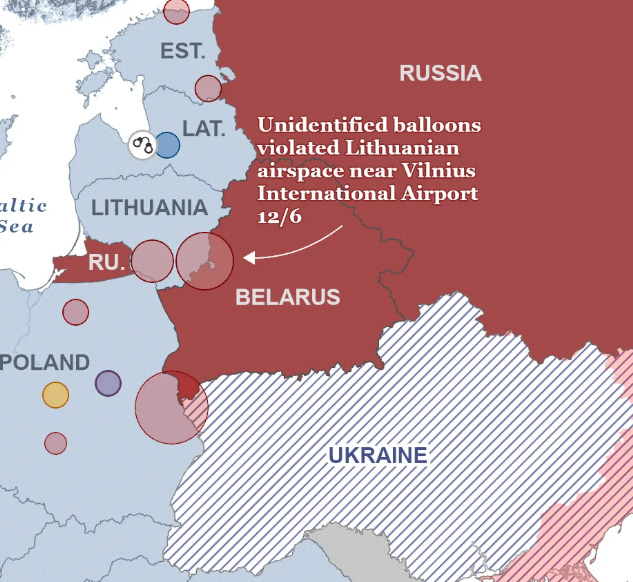
For Ukrainian soldiers, Europe’s delay means blown bridges and empty ammo crates. For Europeans, it shows up as balloons in flight paths and poisons on park benches. Lithuania temporarily closing Vilnius airport because of “balloons” drifting in from Belarus is not a footnote; it is a preview. This is “Phase Zero”: slow, deniable harassment that starts long before the tanks roll. Moscow treats Europe as the front line; Washington’s new strategy confirms that if Europe won’t defend it, no one else will.
The Clarifying Moment
So why call any of this good?
Illusions are dangerous, and Europe has lost its most seductive one—the fantasy that the United States will always step in at the last minute. The new NSS is in black and white: Washington’s priority is stability, not victory. That is terrible. It is also clarifying.
If Europe wants to be treated as an ally rather than a client, it must do what Washington refuses to do:
Unlock frozen Russian assets to give Ukraine a financial lifeline.
Ramp up industrial production so a long war becomes a losing bet for Moscow.
Provide the long-range systems that make aggression a strategic mistake, not a manageable nuisance.
Washington has chosen its version of stability; Europe now has to choose whether to subsidize it. That choice will decide whether this war becomes a warning to future aggressors or a business model. Allies in Asia will read that decision as a verdict on whether American guarantees travel beyond Europe.
For Americans who still believe in deterrence, this is not an argument for isolationism; it is the argument for finally getting the self-reliant European ally we always claimed we wanted.
In the optimistic version, Europe wakes up, retools, and sends enough weapons to turn this war into a catastrophic miscalculation for Putin. In the pessimistic one, Europe keeps waiting for an American rescue that isn’t coming, flinches from using Russian assets, and pays the bill in territory instead of euros.
If Europe still clings to American guarantees after a Kremlin-approved U.S. strategy, it shouldn’t be surprised when the next map of its neighborhood is drafted in Moscow, notarized in Brussels, and sold back to them as “stability”—with the bill attached.