Russia Is Assembling the Target
Moscow is massing for Donbas. But before an offensive moves, it has to be fueled, shielded, commanded, and staged. Ukraine is making the assembly the target.

The offensive does not begin when the first Russian assault group crawls toward a Ukrainian trench. It begins earlier, in places that look less dramatic and matter more: at a loading pier, beside a railway traction substation, inside a refinery unit, at a drone-control point with antennas and tired operators, on a road where a truck can still pretend it is only traffic.
Russia is preparing a real Donbas offensive. Contempt is not analysis, and hope is not a plan. Moscow is not bluffing from a television studio. It is pushing men, drones, artillery, command systems, air defenses, political pressure, and logistics toward the same object it has failed to finish taking for years: Donbas, and especially the belt of cities that keeps the Russian map from becoming Russian control.
But an offensive has to be assembled before it can be launched. Before Russian manpower becomes momentum, fuel has to move. Ammunition has to move. Rail has to function. Command posts have to light up. Air-defense systems have to choose what deserves protection. Each of those things creates a place. Each place creates a signature. Each signature can become a target.
The Kremlin still talks as if territory is the main unit of the war. Dmitry Peskov has tied a ceasefire and peace talks to Ukrainian withdrawal from Russian-claimed regions, even though Moscow has not fully taken them. Putin’s circle still talks about Donetsk and Luhansk as if the legal fiction of annexation can compel Ukrainian fortifications to evacuate themselves.
The battlefield is less obedient. ISW’s May 13 assessment puts Russian gains in Donetsk Oblast at roughly 350 square kilometers since the start of 2026, about 2.6 square kilometers per day. Russian forces first infiltrated the outskirts of Kostyantynivka in October 2025 and have failed to turn that into significant tactical gains over the following months. Moscow wants territory. Ukraine is asking where the fuel, rail, roads, radios, drone crews, depots, air defenses, and officers have to gather before Moscow can take it.
Russia is assembling the target.
Before the Map Moves
Russia’s main military effort is pointed at the Donbas fortress belt: Pokrovsk, Myrnohrad, Kostyantynivka, Kramatorsk, and Slovyansk. These are not just names for map watchers. They are the system of cities, roads, heights, and defensive positions that keep Russia from converting years of violence into one clean political fact.
Ukrainian and open-source assessments describe a Russian concentration toward Donbas, with Pokrovsk and the Kramatorsk-Slovyansk agglomeration as central pressure points. Some reports point to a large concentration of Russian forces in the Pokrovsk sector and possible redeployments intended to increase pressure there. The exact unit count can be disputed. The pattern is harder to miss: Russia is concentrating its effort around Donbas and preparing for a major fight.
It is also not clean. If Russia could drive through, it would. Instead, the repeated pattern is small-group infiltration rather than a decisive mechanized breakthrough. Russian units probe the outskirts, tree lines, and seams. They move under fog, in darkness, amid weather, or in the cover of drones and artillery. They try to appear where control is ambiguous, then dare the map to catch up.
ISW’s May 13 assessment shows the problem. Russian forces launched an attack in northern Sumy without advancing. They conducted limited operations toward Borova without making any advances. They infiltrated near Slovyansk, Kostyantynivka, Stepanivka, Pokrovsk, Oleksandrivka, and Huliaipole, but the question was whether they could consolidate rather than merely appear.
An infiltrator can make a video. An offensive needs supplies.
The infantry is only the visible part. Russia needs men supplied, reinforced, commanded, covered, extracted, and replaced. Ukraine is reportedly striking that machinery: troop concentrations near Tetkino, Varachyne, and Naumovka; a command and observation post near occupied Soledar; a drone-control point and troop concentration near Myrne; command posts near Staromlynivka and Komyshuvakha; manpower concentrations in Kinski Rozdory and Oleshky. These are the working organs of an offensive: command, control, drone work, staging areas, local logistics, and manpower before it reaches a Ukrainian line.
The Russian Witnesses Know It
Russian pro-war voices are already itemizing the cost of keeping the offensive alive.
One Russian pro-war Telegram post put the problem with unusual clarity. The growing number of attacks on frontline logistics, especially along the land corridor to Crimea, is underscoring the need for a comprehensive low-altitude air defense system and protection for supply routes. As drones multiply, Russia needs mobile air-defense systems, FPV-interceptor crews, observation posts, engineering equipment for communication routes, and the personnel to maintain them. Even anti-drone nets, the post noted, require large numbers of people and equipment.
Then came the sentence that turns the Russian buildup into a target diagram: “the density of personnel is increasingly shifting to a depth of 20 to 30 kilometers from the front and beyond. And therefore, as forces accumulate in the rear, the enemy will expand the possibilities of strikes on these areas of support and logistics.”
The quote gives away the trade: more support and more targets behind the line.
A Strelkov-adjacent nationalist account made the same point in the language of shortages: fishing nets, camouflage nets, drones, body armor, helmets, motorcycles, thermal imagers, optics for night air-defense units. The claim that “anything larger than a motorcycle” is “guaranteed” to be destroyed is rhetoric, not data. But rhetoric reveals the shape of fear. The Russian movement has been pushed toward smaller vehicles and improvised protection because larger ones have become too visible, too valuable, or too dead.
The request for nets, motorcycles, optics, and air-defense crews is not a footnote. It is a map of what Russia can no longer move without improvising. The shopping list is the confession.
The Russian state speaks in absolutes. Russian war voices speak in objects.
Men in the Machine
The same machine that the pro-war voices say needs more personnel is failing to account for the personnel it already has.
Russia’s war machine is wounded men whose medical board reports allegedly vanish. It is relatives searching for missing soldiers by scars, teeth, tattoos, and unit numbers. It is the commanders who are accused by families of refusing evacuation. It is mothers writing to prosecutors, investigators, ministries, and anyone else whose title might force a door open.
Telegram grievance channels are not court records. Their claims must stay attributed. But the pattern matters. The machine Russia is assembling for Donbas has already consumed enough men that its own families are becoming archivists of failure. The pro-war voices ask for more bodies in the support zone. The families ask where the existing bodies went. Both questions describe the same system.
On the Huliaipole axis in Zaporizhzhia Oblast, Ukraine’s General Staff alleged that a Russian commander ordered the decapitation and display of the bodies of two fallen Ukrainian soldiers from the 225th Separate Assault Regiment after they were killed in an ambush. Ukraine says the allegation is based on intelligence intercepts; until independently verified, it should remain an allegation. Even with that caveat, the fuel, radios, command posts, and men serve the war Russia actually conducts.
Fuel Is Not Background
A Donbas offensive does not run on speeches. It runs on fuel.
Fuel infrastructure is part of the same assembly phase. Refineries, terminals, pumping stations, and gas processing plants sit outside the trench line, but not outside the war. They belong to the chain that turns crude, storage, and pipeline systems into military motion and state revenue.
The Lukoil Perm refinery is the clearest case. Reuters reported, citing industry sources, that a May 7 Ukrainian drone strike forced Perm to halt processing completely, with repairs expected to take weeks. The facility processed about 12.6 million tons of crude in 2024, roughly 250,000 barrels per day. Taking that offline does not collapse the Russian fuel supply. In a wartime balance already strained by export disruption, sanctions, and rising domestic demand, it forces tradeoffs that did not exist before: which buyers go short, which depots draw down, which prices rise inside Russia itself.
That is not just an explosion. It is a subtraction.
Strikes against Tamanneftegaz, Yaroslavl, Astrakhan, Nurlino, and Orenburg facilities in the same window extended the geography of the problem. Ukrainian officials said the May 13 strikes hit the Tamanneftegaz oil terminal, the Yaroslavl refinery, and the Astrakhan gas processing plant. Zelenskyy also said Ukrainian forces struck Russian gas infrastructure in Orenburg Oblast more than 1,500 kilometers from the border. The official Russian grammar was familiar: debris, not strike; small fire, not system exposure; situation under control, not a facility learning it is reachable.
The refinery, unhelpfully, still had to stop refining.
A refinery shutdown only has to remove capacity, delay repairs, and complicate supply. Then comes the miserable question: troops, Moscow, a port, a refinery, a gas plant, or the next statement about debris?
The Shield Is Part of the Target
The target is not only fuel. It is the shield around the fuel, too.
Der Spiegel reported that Ukraine has been destroying more Russian air-defense systems and radars than before, while the number of precise strikes on Russian support and industrial targets has increased. Medium-range Ukrainian drones, the magazine said, have become especially dangerous because newer models can operate with more autonomy, using maps and sensors to navigate around defenses. Systems such as Tor and Buk, and in some cases even the S-300, are no longer simply pieces of the Russian shield. They are themselves part of the target list.
Air defense is not a mood. It is hardware, crews, radars, launchers, fuel, maintenance, positions, and decisions. Moscow has to decide what to cover. Available reporting suggests Russia is thickening coverage around Moscow, the Crimea land bridge, the Black Sea logistics corridor, and politically sensitive industrial zones. The vulnerable gap is farther inland. Bashkortostan, Perm, Orenburg, and the deeper refining belt were not defended as if Ukrainian drones would be arriving there. They are no longer beyond reach, and rebuilding coverage that far inland trades batteries away from places that already need them.
Every battery moved toward a refinery is a battery not covering troops. Every system kept near troops is a gap somewhere else.
Der Spiegel also described the public consequence inside Russia: more regions hearing sirens, more residents watching the old assumption of distance break down. Air-defense scarcity is no longer a staff problem hidden in a planning room. It is something civilians notice when the alarm sounds, when mobile internet fails, when officials say debris again, and when the official photograph arrives late because the first photograph was banned.
A hole near the front matters. A hole over a refinery matters. A hole near a drone plant matters. A hole around Moscow matters because Moscow has built a state that treats embarrassment as a security category. A shield spread across a continent becomes less like armor and more like a schedule, with too many appointments and too few batteries.
The Sky Was the Test
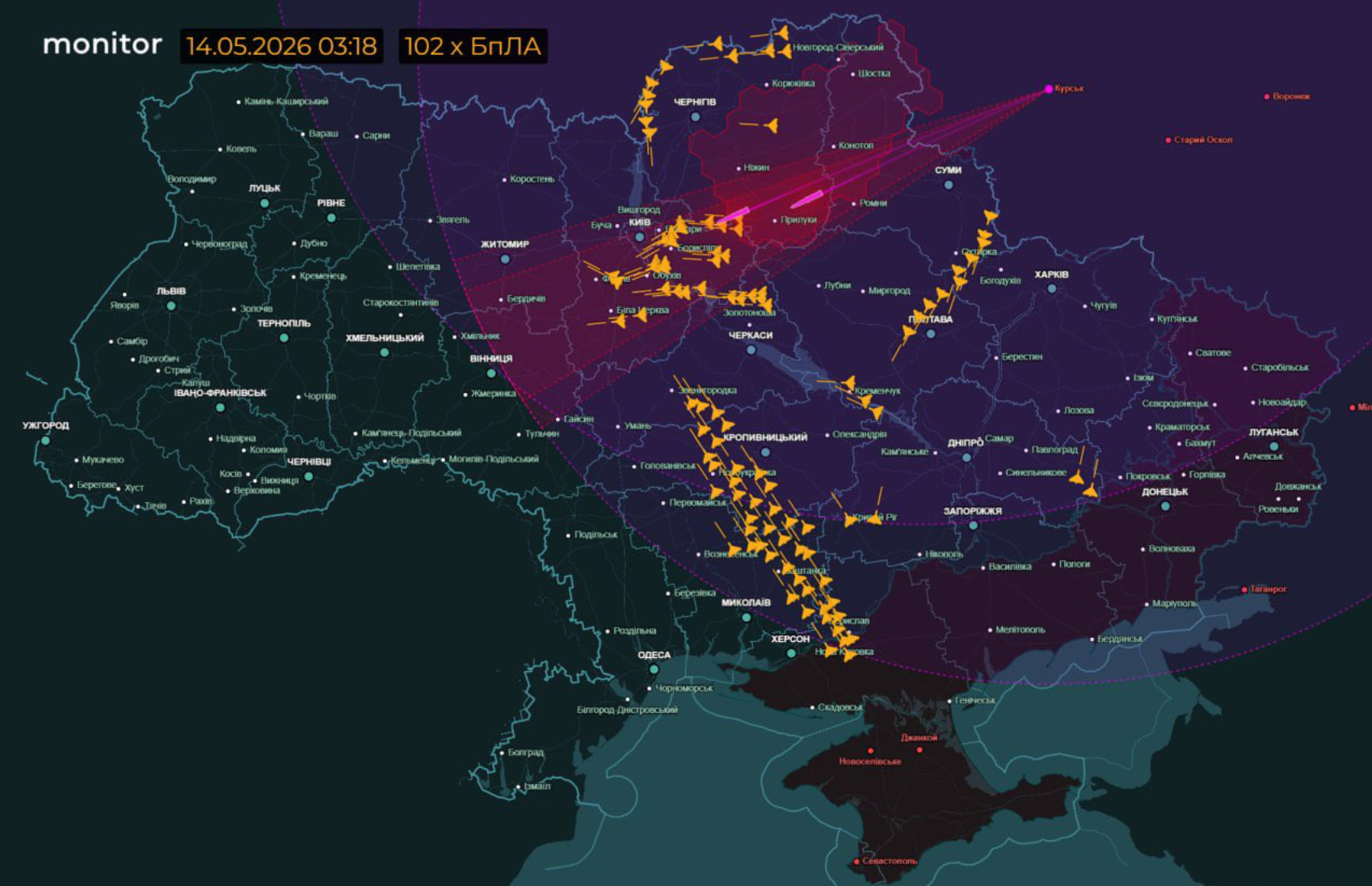
On May 13, Russia tried to overload the sky. Ukrainian officials reported 139 drones overnight and more than 750 during the daytime attack, bringing the total assault to over 800 drones. Air defenses downed most of them, but drones and debris still hit across the country. Ukrainian officials said civilians were killed and wounded, including children.
The attack came in waves, the kind of pressure meant to make defenders spend interceptors, track too many routes, and wait for the next shape on the screen. That is the point of saturation: not only to hit what gets through, but to make the defender show where the shield is thick, where it is thin, where it is tired, and where the next wave might get luckier.
Railways were a major object. Ukrainian presidential adviser Dmytro Lytvyn said 23 railway facilities were hit. Monitoring teams stopped and evacuated trains in advance, preventing passenger casualties. Two off-duty railway workers were killed in Zdolbuniv, and another person was injured. The damage list is practical enough to be cold: three locomotives, seven commuter rail cars, eight freight cars, five traction substations, five depots, two bridges. Railway traffic continued. A railway that keeps moving under attack is a country refusing to let the attacker decide when its nervous system shuts down.
Ukrainian officials described the attack as a prolonged strike in which large drone waves could exhaust air defenses before possible missile follow-on attacks. Russian pro-war channels described the same logic from the other side, citing Ukrainian assessments that Russian drones were flying along the Belarusian border in large numbers to overload Ukrainian air defense and push targets deeper into the country. The apparent aim was to make Ukraine’s defenses show themselves through exhaustion.
Moscow Defends the Photograph
On May 13, Moscow banned the publication of photos and videos showing the aftermath of drone strikes and other attacks without official permission. The restrictions applied to media, individuals, and emergency services until images were officially released by Russia’s Defense Ministry or the Moscow city government. The stated reason was fighting unreliable information. The practical purpose was to control the time between the explosion and the explanation.
The state could not prevent the blast, so it moved to regulate who was allowed to notice it first.
Two Majors understood the problem faster than the bureaucrats did. The channel asked whether the rule would make pro-Russian sources afraid to write anything describing consequences. If Russian sources remained silent, Ukrainian sources would fill the information space. Then came the line that should be posted above every censorship desk: “the information field is surrendered to the enemy without a fight, with the clatter of heels and brave reports of victory on this front too.”
That is a Russian pro-war channel complaining that Moscow is trying to defend the state by blinding its own side.
Russia has to assemble the offensive, but it also has to assemble the story of the offensive.
A refinery is harder to censor than a sentence. ISW, citing RBK and Bank of Russia data, reported that cash in circulation rose by 210.5 billion rubles between April 30 and May 11, the largest increase since the Bank of Russia began collecting the data in 2011. A Raiffeisenbank-Russia economist linked the withdrawals to internet restrictions around the same period. A state can call the war distant. People still take out cash when the network becomes unreliable, and the state becomes too interested in transactions.
Border Regions Become War Offices
Putin replaced the heads of Belgorod and Bryansk, two regions bordering Ukraine, repeatedly hit during the war. Belgorod’s Vyacheslav Gladkov and Bryansk’s Alexander Bogomaz were reported to have stepped down at their own request. Alexander Shuvayev, a decorated military veteran, took over Belgorod. Yegor Kovalchuk took over Bryansk. The paperwork was calm. The geography was not.
Belgorod has become one of the most visible domestic costs of the invasion: attacks, blackouts, drone pressure, rail disruption, evacuations. A pro-war voice described Belgorod as an almost permanent front-line region. The border no longer protects the Russian interior from the consequences of the Russian state.
The same logic sits behind Russian legislation expanding Putin’s authority to deploy forces abroad to “protect” Russian citizens facing arrest, detention, or prosecution. “Protecting Russians” was one of the costumes used for aggression against Ukraine. The costume is being kept ready for future use.
Russia is assembling men and fuel, but also governors, legal pretexts, censorship rules, and propaganda frames. The battlefield needs roads and depots. The state keeps decrees, bans, and pretexts ready.
The Peace Terms Are Another Offensive
The peace talk is not separate from the offensive. It is one reason Russia is assembling it.
Trump says the war is getting closer to an end. Putin suggests the matter may be coming to an end. Russian officials discuss talks with Washington. The Russian condition remains maximalist: Ukraine should withdraw from the territory that Russia claims and has not fully taken.
That is not compromise. It is an attempt to make diplomacy complete the offensive. Russia wants the negotiating table to take what the army has not yet taken.
The Financial Times, citing unnamed sources, reported that Russian commanders have convinced Putin they can seize all of Donbas by autumn and that Putin may raise the price of any ceasefire by expanding territorial demands. ISW is more skeptical, noting that Russia’s ambitions run against battlefield reality and that Russian advances in Donetsk remain slow.
That gap between demand and capacity is where the offensive is being assembled. The more Russia can assemble before talks, the more it can demand once it sits down. Putin needs battlefield progress to make the demand look less absurd. The army needs logistics. Logistics need protection. Protection needs air defense, and air defense already has too many places to be. Every demand creates another exposed object.
Destroying a command post near Soledar does not merely affect a local fight. Forcing a refinery shutdown in Perm does not merely subtract barrels. These attacks raise the cost of turning military preparation into diplomatic leverage. Moscow wants to arrive at talks with facts on the ground. Ukraine is attacking the machinery that produces those facts.
Russia Can Still Kill
Ukraine can hit the system. That does not mean the killing has stopped.
It can still kill civilians, damage railway infrastructure, overload air defenses, wound children, destroy apartments, and impose days of fear on cities far from the front. Ukrainian air defenses destroyed large numbers of drones on May 13, but some still got through. The difference between high interception rates and one drone hitting a residential building is measured in human beings, not percentages.
Ukraine’s reach has limits of its own. The drone industry that gives Ukraine that reach is under pressure: production constraints, corruption investigations, foreign dependencies, and the permanent difficulty of building weapons while using them.
Still, allies are studying battlefield methods Ukraine built under fire. A draft U.S. testing arrangement for Ukrainian unmanned systems would allow Ukrainian drones to be temporarily exported for American testing and evaluation. Ukraine and Lithuania have also announced a drone-focused defense agreement built around cooperation, production, technology transfer, and possible localized manufacturing. None of that stops the next attack by itself. It shows something narrower: Ukraine still needs allies, but its battlefield drone and counter-drone methods are becoming something allies want to test, import, and adapt.
Russia is assembling mass. Ukraine is assembling methods.
Russia still has depth, money, people, violence, and a high tolerance for waste. It can attack. But every serious offensive now has to expose more of itself than the Kremlin wants to admit.
The Target Takes Shape
Russia wants a territorial fact. Ukraine is striking the machinery that would produce it.
Moscow wants to arrive at any negotiation with either a completed offensive or a credible threat of one. Ukraine is making both harder by attacking the assembly phase itself. That slows the offensive’s completion by subtracting fuel, command, manpower, and air-defense cover. Manpower, in this war, is not an abstraction; it is wounded men, missing men, families writing ministries, and bodies the system struggles to account for.
Russia cannot fully protect what it is gathering. The threat is still real. So are the places where it has to gather.
An unfinished offensive is not the same bargaining position as a finished one. A support zone that can be seen, struck, and forced to improvise is not the silent, untouchable depth Moscow used to enjoy.
Before the offensive can move, it has to appear somewhere. The assembly is visible now, and anything visible can become a Ukrainian target before Putin can put it on a map.
Russia can still launch the offensive. The problem is that it has to assemble the target first.
Very nice synthesis.